Showing posts with label India. Show all posts

Sloth Bear - India


According to a United Nations report, India is expected to surpass China as the world’s most populous country by 2028, when its population is estimated to reach 1.450 billion. China and India are working on practical solutions to their rising populations, a factor straining the “carrying capacity” of both countries.

- - - - -

Melursus ursinus - The sloth bear is an ancestor of the brown bear, but is leaner in appearance, has longer claws, and a specially adapted mouth for eating its preferred food, termites. The sloth bear has a keen sense of smell and can find termite nests buried 1 meter below ground. The sickle-shaped claws of the sloth bear can easily dig up a termite mound and by contorting its specially design lower lip, the bear can either vacuum up exposed termites by inhaling or puff away dirt and debris by exhaling to expose more termites.

Wandering Violin Mantis - India


Gongylus gongylodes - The wandering violin mantis is native to Southern India and Sri Lanka. It has extremely thin limbs and grows to about 10 centimeters in length; males being slightly smaller. The violin mantis is a social insect, living and breeding in large groups. The joints and abdomen resemble twigs and leaves to allow the mantis to blend in with the foliage as it waits in ambush for unsuspecting insects to pass close enough to be snatched up. The violin mantis rarely resorts to cannibalism.

- - - - -

The East India Company was granted a charter by Elizabeth I in 1600, for the purpose of pursuing trade with the East Indies. The Battle of Plassey, fought in 1757, resulted in a British victory over the Mughal Empire, Bengal forces, and the French. The victory allowed the East India Company to establish a trade monopoly over India. Through the use of private armies, the East India Company retained its hold over India until the British government took direct control of India by creating the British Raj in 1858.

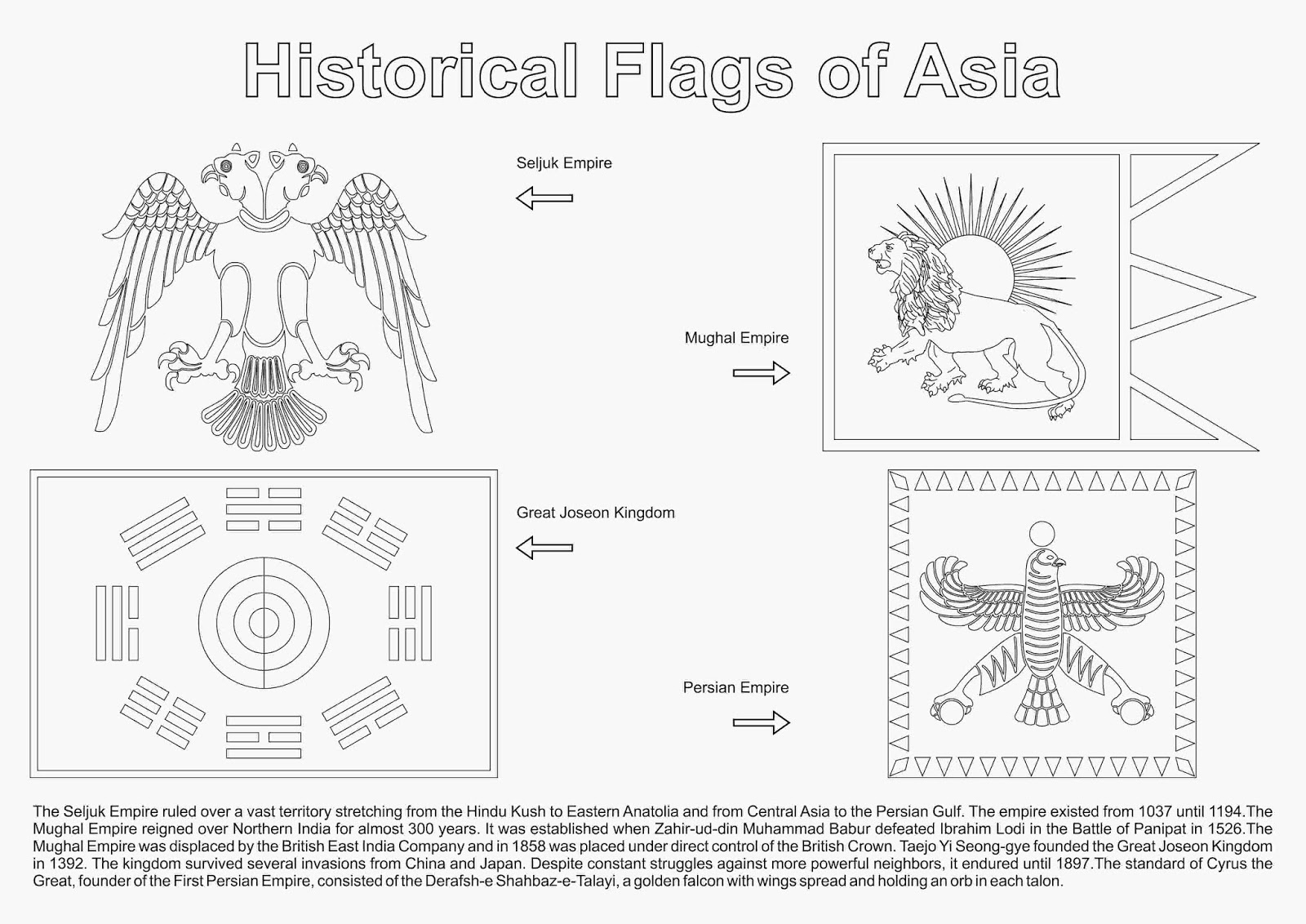
Historical Flags of Asia


The Seljuk Empire ruled over a vast territory stretching from the Hindu Kush to Eastern Anatolia and from Central Asia to the Persian Gulf. The empire existed from 1037 until 1194.The Mughal Empire reigned over Northern India for almost 300 years. It was established when Zahir-ud-din Muhammad Babur defeated Ibrahim Lodi in the Battle of Panipat in 1526.The Mughal Empire was displaced by the British East India Company and in 1858 was placed under direct control of the British Crown. Taejo Yi Seong-gye founded the Great Joseon Kingdom in 1392. The kingdom survived several invasions from China and Japan. Despite constant struggles against more powerful neighbors, it endured until 1897.The standard of Cyrus the Great, founder of the First Persian Empire, consisted of the Derafsh-e Shahbaz-e-Talayi, a golden falcon with wings spread and holding an orb in each talon.