Showing posts with label Chickens - Partridges - Pheasants. Show all posts

Sharp-tailed Grouse - Saskatchewan


Saskatchewan experienced its arrival on the Canadian scene with the building of the Canadian Pacific Railway and the government’s Dominion Land Survey, an act granting parcels of land to willing settlers. Saskatchewan was carved out of the vast Northwest Territories holdings and given provincial status in 1905.

- - - - -

Tympanuchus phasianellus - Each spring the male sharp-tailed grouse moves to his traditional “dancing” ground to perform a ritual breeding dance. He brings his tail feathers up, shakes them, and struts about in circles with wings outstretched while stomping his feet vigorously. The large purple neck sac will inflate with air and make a low cooing sound as the air is slowly released in an attempt to attract a potential mate. This type of mating dance is known as “lek mating.” Lekking is a more noticeable trait among avian species.

Rock Ptarmigan - Nunuvat


Nunuvat covers 1/5 of Canada’s land mass. It hosts the northern most permanently inhabited place on earth and is the largest sub-division of Canada, yet it also contains the smallest population of any Canadian province or territory. The Nunuvat Territory was created in 1999 by splitting it off from the Northwest Territory.

- - - - -

Lagopus muta - The rock ptarmigan moults from a summer brown to a winter white coloration to blend in with the seasonal changes. It is a sedentary bird inhabiting the arctic and subarctic regions of the Americas and Eurasia. The primary diet consists of feeding on the buds from birch and willow trees; the developing juveniles add insects to their diet. Females and chicks find refuge near brushy areas to stay hidden from potential predators. Males leave the females for the open tundra once the females begin the incubation period.

Grouse of North America


Grouse can be found along a broad path stretching from Greenland to Texas and across the entire Northern Hemisphere. There are about 19 species and each has adapted to either a forest, prairie or tundra environment. Relying primarily on camouflage for protection, flight is possible. A sudden burst will take the bird into a low-level glide to escape danger; mothers will feign injury to lure threats away from their young.

Wild Turkey - Massachusetts


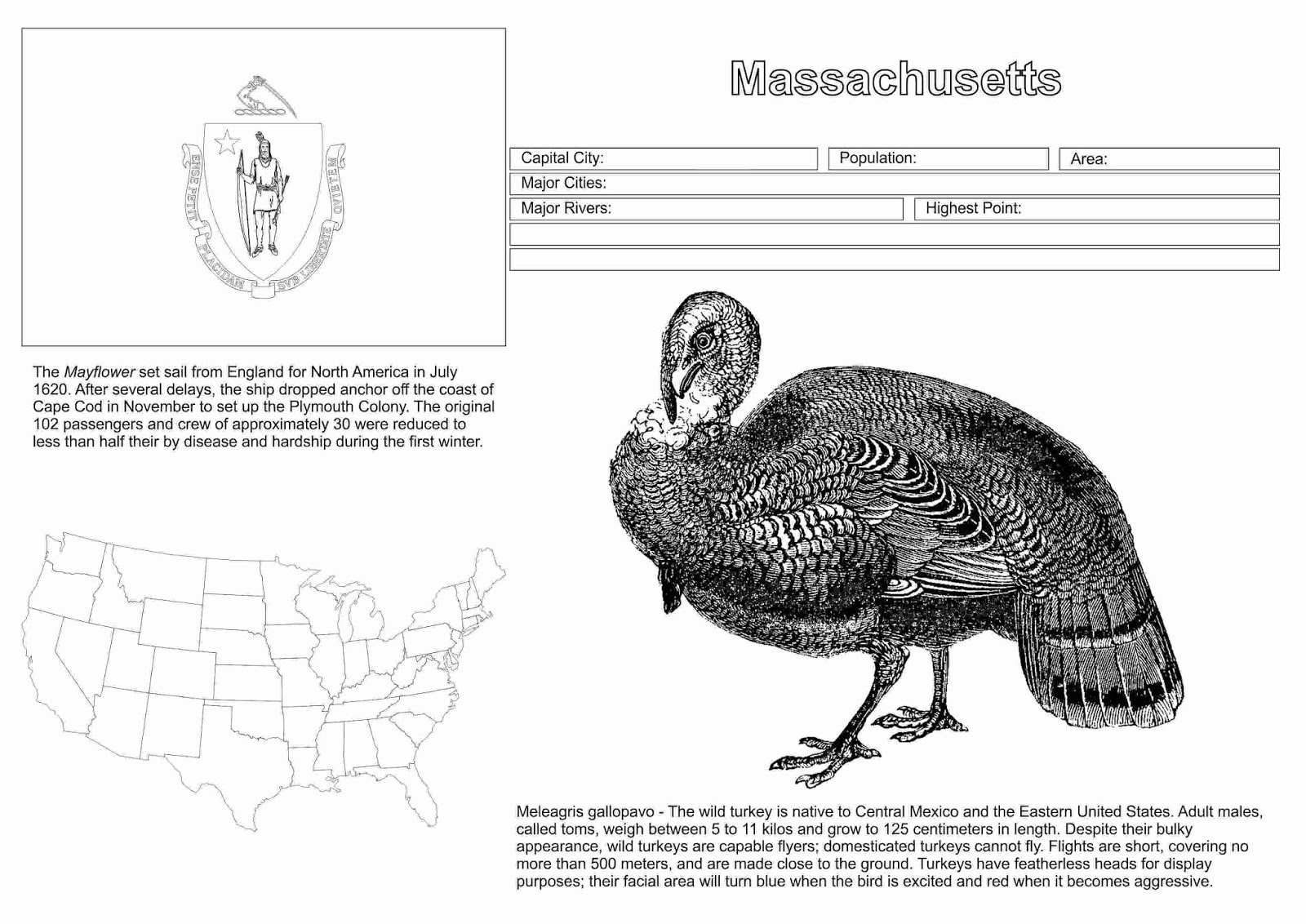
The Mayflower set sail from England for North America in July 1620. After several delays, the ship dropped anchor off the coast of Cape Cod in November to set up the Plymouth Colony. The original 102 passengers and crew of approximately 30 were reduced to less than half their by disease and hardship during the first winter.

- - - - -

Meleagris gallopavo - The wild turkey is native to Central Mexico and the Eastern United States. Adult males, called toms, weigh between 5 to 11 kilos and grow to 125 centimeters in length. Despite their bulky appearance, wild turkeys are capable flyers; domesticated turkeys cannot fly. Flights are short, covering no more than 500 meters, and are made close to the ground. Turkeys have featherless heads for display purposes; their facial area will turn blue when the bird is excited and red when it becomes aggressive.

Common Pheasant - Georgia


Three scripts are used for writing in Georgian: Asomtavruli, Nuskhuri, and Mkhedruli with the latter script reserved for everyday usage. Asomtavruli and Nuskhuri are primarily used in ceremonial writings; Asomtavruli is the oldest of the scripts. The three scripts make no distinction between upper and lower case lettering.

- - - - -

Phasianus colchicus - The adult male common pheasant is approximately 60 to 86 centimeters in length, with a long tail accounting for 50 centimeters of the total length. The male’s plumage is gold with black or brown dabbing. The neck and head contain purple, green, and white covering and feature a bright red wattle hanging underneath each eye. Females are more drab in appearance; a mottled brown color and they are much smaller than males. Male juveniles do not show their flashier side until about 10 weeks after hatching.

Red Jungle Fowl - Laos


Laos, once covered by vast stretches of unblemished jungles, has in recent decades seen the amount of land dedicated to forests decrease dramatically. Agriculture provides 80% of Laotian employment and clearing new lands places high demands on a shrinking forest, the leading cause of deforestation in Laos.

- - - - -

Gallus gallus - The red jungle fowl is the ancestor of the domesticated fowl. The male has a large fleshy comb and silky plumage of red, black, and green variations while the female is of a rusty brown color, a speckled neck, and a minimal comb. The courtship ritual of the male jungle fowl consists of an elaborate display, a trait evident in the domesticated fowl. There is a strictly enforced pecking order within groups; one for males and one for females. Newly hatched chicks are introduced to these pecking orders within a week after hatching.

Grey Partridge - Hungary


Budapest had once been three separate cities situated along the Danube River with Buda and Óbuda located on the west bank and Pest located on the east bank. The three cities merged to form Budapest in 1873. The Széchenyi Chain Bridge, completed in 1849, is the oldest bridge crossing the Danube in Budapest.

- - - - -

Perdix perdix - The grey partridge has the typical appearance common to the pheasant family; a plump body, short tail, and the preference to running from danger instead of flying. They have strong breast muscles to power an explosive takeoff, but those flights are low and usually of short duration. The grey partridge feeds primarily on grass and seeds. Females will add insects to their diet during the breeding season to assure a healthy clutch of eggs; up to 16 eggs can be produced, the largest clutch of any living bird.

Western Capercaillie - Kosovo

Kosovo is divided into 7 districts: Ferizaj, Gjakovo, Gijlan, Mitrovica, Peja, Pristina, and Prizren. Pristina is the largest in population and area. The 7 districts are divided into 38 municipalities with each containing several settlements. Districts and municipalities are typically established along Albanian or Serbian ethnic majorities.

- - - - - 

Tetrao urogallus - The western capercaillie, also known as the wood grouse, is the largest member of the grouse family. Adult males are 75 to 85 centimeters in length and have wingspans of 90 to 125 centimeters. The average weight of a male is about 4 kilograms. Females are 55 to 65 centimeters in length, wingspans average about 70 centimeters, and body weight is about 2 kilograms. The mating season runs from late March to early June and is defined by the male wooing a female with elaborate dances featuring a symphony of clicking and popping sounds.