Showing posts with label Saint Lucia. Show all posts

Queen Conch - Saint Lucia


In 1605, an English ship, the Olive Branch, was blown off course and made landfall on Saint Lucia. The crew, impressed with what they saw, considered establishing a permanent settlement. They were subjected to a fierce Carib attack and only 19 of the original 67 crew members managed to escape the island.

- - - - -

Lobatus gigas - The queen conch, a sea snail, is a member of the Strombidae family. It is the largest conch endemic to the tropical Northwestern Atlantic, growing to a shell length of approximately 35 centimeters. The queen conch, once believed to be carnivorous, is a specialized herbivore feeding primarily on macroalgae and unicellular algae. The queen conch prefers deeper water, up to 35 meters, but if necessary, it will venture into shallow waters to be near a steady supply of food. Over-harvesting has resulted in a population decline.

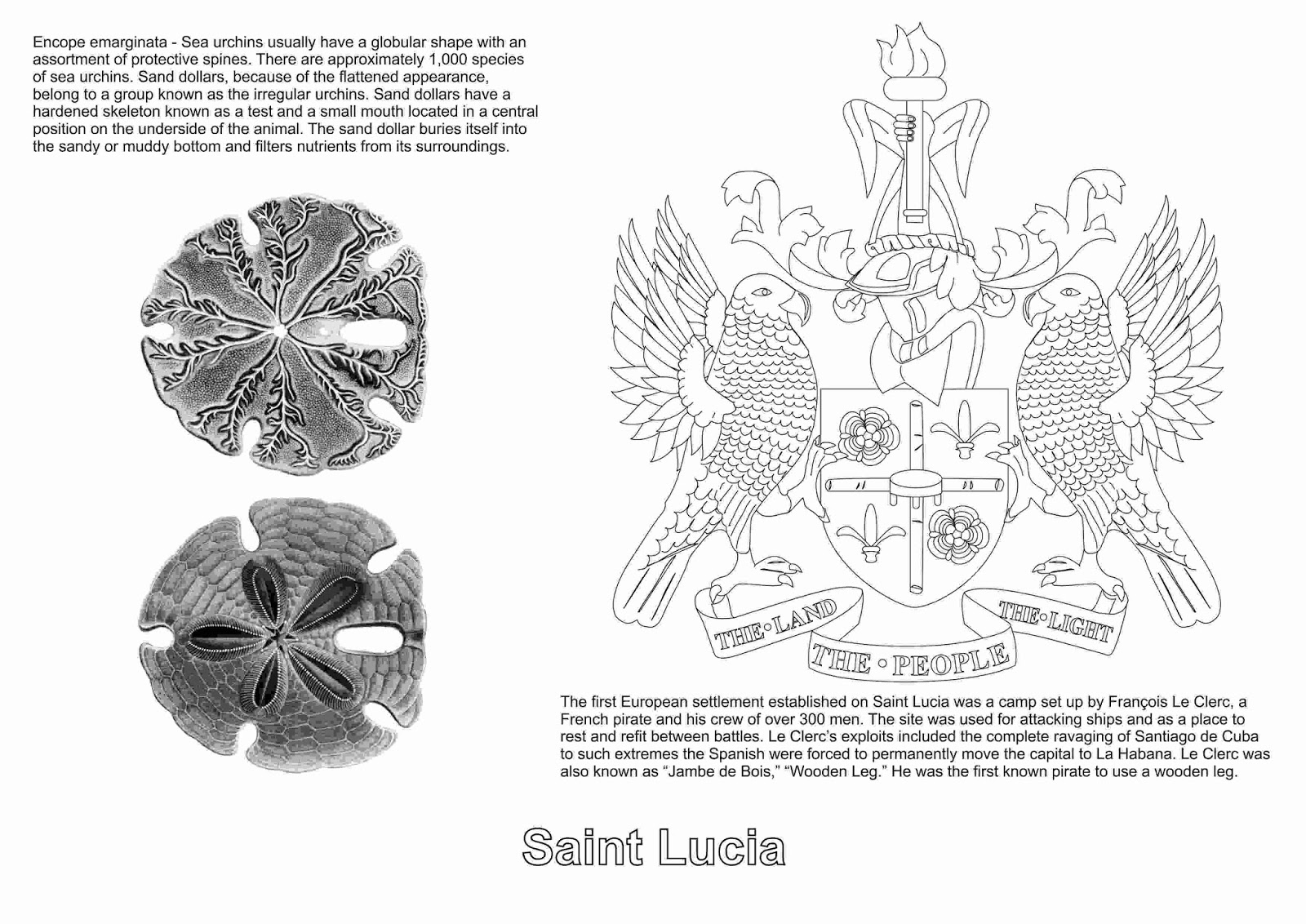
Sand Dollars - Saint Lucia


Encope emarginata - Sea urchins usually have a globular shape with an assortment of protective spines. There are approximately 1,000 species of sea urchins. Sand dollars, because of the flattened appearance, belong to a group known as the irregular urchins. Sand dollars have a hardened skeleton known as a test and a small mouth located in a central position on the underside of the animal. The sand dollar buries itself into the sandy or muddy bottom and filters nutrients from its surroundings.

- - - - -

The first European settlement established on Saint Lucia was a camp set up by François Le Clerc, a French pirate and his crew of over 300 men. The site was used for attacking ships and as a place to rest and refit between battles. Le Clerc’s exploits included the complete ravaging of Santiago de Cuba to such extremes the Spanish were forced to permanently move the capital to La Habana. Le Clerc was also known as “Jambe de Bois,” “Wooden Leg.” He was the first known pirate to use a wooden leg.