Showing posts with label Palm Trees. Show all posts

African Oil Palm - Equatorial Guinea


Elaeis guineensis - The African oil palm is a primary source of palm oil, an oil used by the commercial food industry throughout the world. It is native to West and Southwest Africa, but is now distributed along the world’s tropical regions. An oil palm can grow to heights of 20 meters and produce several clusters of fruit, each bunch weighing as much as 50 kilograms. The pulp of the fruit produces an edible oil and the palm kernel oil is used as a food additive and in the manufacturing of soap.

- - - - -

In 1472, Portuguese explorer Fernão do Pó became the first European to make landfall on Bioko Island, now part of Equatorial Guinea. The Treaty of El Pardo, signed by Spain and Portugal in 1778, ceded the area, including Rio Muni, to Spain. The British, having banned slavery in 1833, used an outpost on Bioko to disrupt the slave trade of other nations. Spain began to lose control of its few African holdings and bowed to international pressure by granting independence to Equatorial Guinea in 1968.

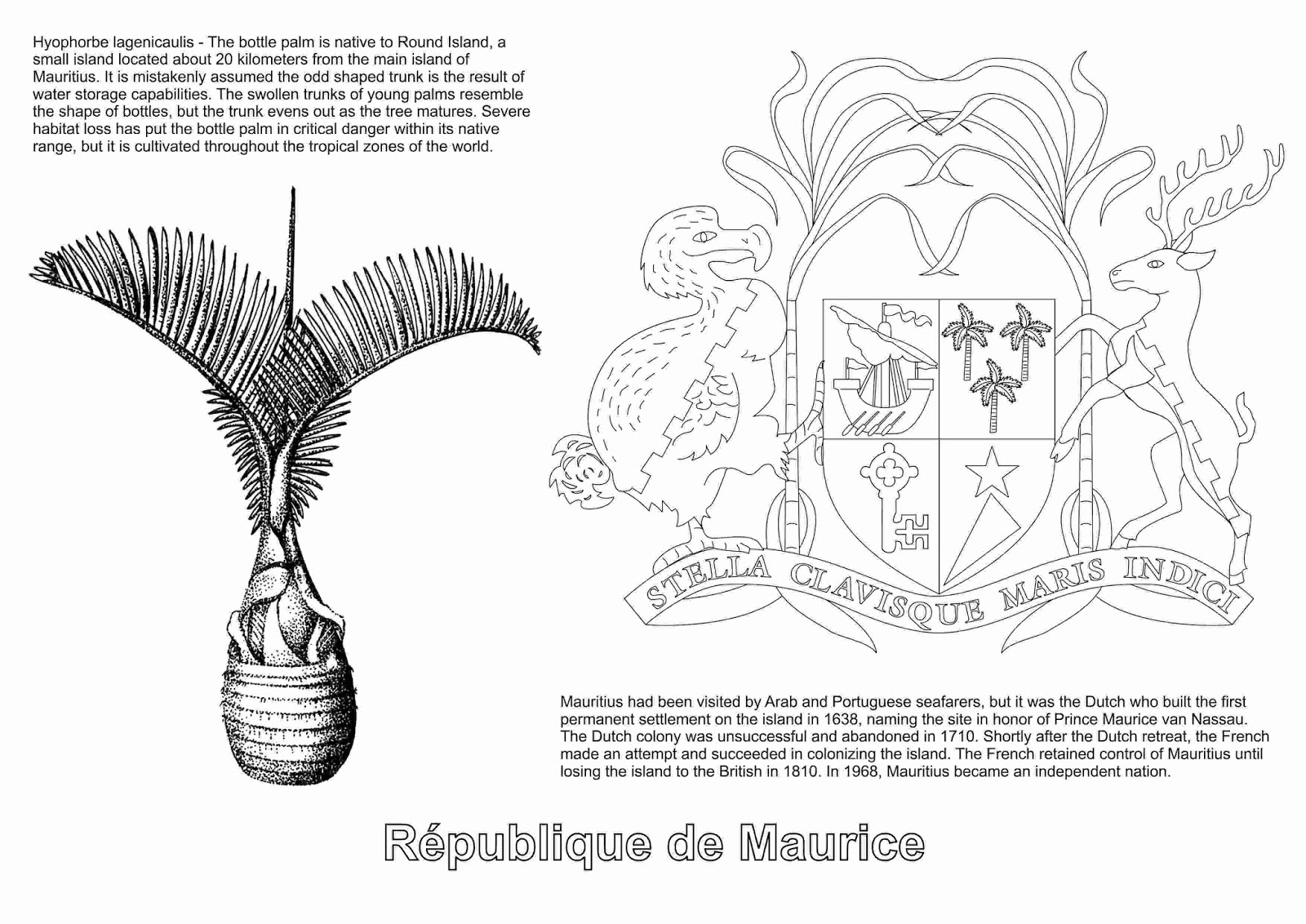
Bottle Palm - Mauritius


Hyophorbe lagenicaulis - The bottle palm is native to Round Island, a small island located about 20 kilometers from the main island of Mauritius. It is mistakenly assumed the odd shaped trunk is the result of water storage capabilities. The swollen trunks of young palms resemble the shape of bottles, but the trunk evens out as the tree matures. Severe habitat loss has put the bottle palm in critical danger within its native range, but it is cultivated throughout the tropical zones of the world.


- - - - -

Mauritius had been visited by Arab and Portuguese seafarers, but it was the Dutch who built the first permanent settlement on the island in 1638, naming the site in honor of Prince Maurice van Nassau. The Dutch colony was unsuccessful and abandoned in 1710. Shortly after the Dutch retreat, the French made an attempt and succeeded in colonizing the island. The French retained control of Mauritius until losing the island to the British in 1810. In 1968, Mauritius became an independent nation.

Kosi Palm - Mozambique


Raphia - Palm trees have the longest leaves of any trees and the raphia family, consisting of approximately 20 species, contains one palm, the Kosi palm, whose fronds can reach over 20 meters in length. It is endemic to Mozambique and South Africa. The Kosi palm tree grows to heights of about 16 meters. This palm is monocarpic, a plant producing a single flowering before dying. The Kosi palm takes almost 30 years before reaching its one and final flowering stage.

- - - - -

Mozambique and the Mozambique Channel derive their name from an island located in the northern area of the channel. The island is named after Sultan Ali Musa Mbiki, ruler of the island during Vasca da Gama’s visit in 1498. The island served as an important boat building and repair center for ships passing through the channel. The Portuguese built a naval base on the island in 1507, followed by a military base. The island became the headquarters of the Portuguese East African Colony.

Doum Palm - Tunisia


Hyphaene thebaica - The doum palm, also referred to as the gingerbread tree, is native to the Arabian Peninsula and Northern Africa. It can tolerate hot and dry regions with access to groundwater; wadis and oases offer ideal environments. The palm produces a fruit covered in a edible rind with a gingerbread taste, a reflection of its English name. The fronds are woven together by the local population for wide variety of uses; sleeping mats, baskets, wicker furniture, and roof thatching.

- - - - -

Tunisia had been ruled as an autonomous and semi-independent state within the Ottoman Empire and enjoyed the ability to self-govern itself. In an attempt to modernize Tunisia through social and economic reforms, Muhammad III as-Sadiq established closer ties with Europe. Borrowing heavily from European banks, he brought on a financial crisis in 1869 and forced Tunisia into bankruptcy. France invaded Tunisia in 1881 and created a protectorate lasting until 1956, when Tunisia became independent.

Walking Palm Tree - Ecuador


Socratea exorrhiza - The walking palm is a tall tree native to the rainforests of Central and South America; it can grow to heights of 25 meters. The function of the stilts growing from the bottom of the narrow trunk has been the topic of debate. One claim suggests the palm could spend out stilts, acting as levers, to right itself if the fall of a nearby tree causes it to topple over. The stilts might also keep the base of the trunk out of flood waters or allow the palm to grow on steep hillsides.

- - - - -

Ecuador was part of the Inca Empire prior to the arrival of the Spanish conquistadors in 1531, but archeological findings of the Valdivia community reveals the existence of a significant pre-Colombian society on Ecuador’s Santa Elena Peninsula. Dating between 3500 and 1800 BC, it was among the first American cultures to use pottery and to cultivate cotton for use in making clothing. The Valdivian people relied on fishing and farming for their basic needs, but would occasional hunt to supplement their diet.

Coconut Palm - Maldives


The Maldives Islands are spread out over an archipelago of more than 1,200 islands and atolls, none higher than 3 meters above sea level. Long term climatic changes are causing more than rising sea  levels. The Maldives Islands are facing beach erosion, storm surge flooding and a severe fresh water shortage.

- - - - -

Cocos nucifera - The coconut is not a nut. It is a drupe, a stone fruit surrounded by an outer fleshy skin. Other drupes include coffee, mangos, olives, peaches, and apricots. The coconut’s origin is debated; it has been cultivated by humans throughout history. Coconut trees grow in the tropical regions of the world. The coconut has many uses: the flesh can be eaten or used for making oil, the water contained in the flesh is potable, the fibrous husk can be used as a rope making material, and the shell can be made into utensils or containers.

Date Palm - Saudi Arabia


Phoenix dactylifera - The date palm is primarily cultivated for the fruit it provides. The date palm is a dioecious plant; it is either male or female. Male date palms do not produce fruit and are only viable as pollinators. In the wild, pollination is achieved by the wind and in cultivated settings, it is often pollinated manually. Date palms are an important food source, but a typical tree needs at least 4 to 8 years before bearing its first fruit and reaches a maximum yield capacity between 7 and 10 years.

- - - - -

What had once been four separate regions under the control of local chiefs, emirs, and sharifs. The regions Hejaz, Najd, Al-Hasa, and 'Asir, were unified into one state through the conquest of Ibn Saud in 1932. His dynastic line continues to rule Saudi Arabia. The new kingdom seemed irrelevant in its first few years of existence, but when huge deposits of oil and gas were discovered in 1938, Saudi Arabia emerged as a leading exporter of fossil fuels.

Big Mountain Palm - Lord Howe Island


The Tasman Sea, named after Dutch explorer Abel Tasman, is located between New Zealand and Australia. The sea has a surface area of about 2,300,000 square kilometers. Norfolk Island and Lord Howe Island, both administrated by Australia, are the two primary midsea island groups in the Tasman Sea.

- - - - -

Hedyscepe canterburyana - The big mountain palm, also known as the umbrella palm, is a slow growing tree native to Lord Howe Island. Wet mountain forests in altitudes ranging from 335 to 830 meters are the preferred settings. When mature, it stands at a height of about 10 meters and has a lifespan lasting from 40 to 150 years. The big mountain palm thrives in stony soil of basalt origin and keeps moist through the frequent showers falling from the semi-permanent low cloud cover. The fruit spikes contain bright red seeds and grows below the crownshaft.

Palm Trees of Australia


Arecaceae is an order of perennial plants commonly referred to as palms. This order contains climbers, shrubs, and trees. There are about 2,600 species classified into 180 genera within the Arecaceae order. Most palms are endemic to the dry deserts or wet rain forests throughout the tropical and subtropical regions of the world. Palm leaves, known as fronds, are either palmately, fan-leafed or pinnately, feather-leafed. The cabbage-tree palm, Livistona australis, grows to heights of 25 meters. It is found in the moist forests or swampy wetlands throughout the coastal regions of New South Wales. The foxtail palm, Wodyetia bifurcata, is endemic to Queensland’s Cape Melville area. It is listed by the IUCN as a rare palm. The carpentaria palm, Carpentaria acuminata, is a fast grower and reaches heights of  20 meters. It can be found in the tropical regions of Northern Australia. 

Salak Palm - Brunei


Brunei, one of the world’s smallest nations, once held claim over an area extending from Northern Borneo to the southern islands of the Philippines. Internal strife and European intervention weakened the empire. When independence from Great Britain was achieved in 1984, only two small enclaves in Northern Borneo remained.

- - - - -

Salacca zalacca - The fruit of the salak palm grows in tightly packed clusters at the base of the plant and is known as snake fruit because of the scaly rind. The covering peels away to reveal an inner pulp consisting of three lobes resembling the shape of garlic cloves with a texture similar to the pulp of an apple, but having a sweet acidic taste. The salak palm is indigenous to Indonesia, Malaysia, and Brunei. The tree’s long petioles, the stalks holding the leaves to the stems, are strong and flexible enough to be fashioned into fishing rods.

Balaka Palm - Fiji


Balaka seemanii - The balaka palm, also known as the spear palm, is endemic to Vanua Levu and Taveuni islands. This delicate palm thrives in the understory layers of rainforest settings at elevations of 140 meters and up. The palm grows to a height of about 7 meters; the slender trunk rarely exceeds 3 to 4 centimeters in diameter. Warfare between the various Fijian tribes was common and the trunk of the balaka palm was the primary source used for making spears.

- - - - -

Fiji consists of two groups of ethnic peoples; the Melanesians and Indo-Fijians; about 54% and 38% respectively. The colonial domination of Fiji by Great Britain culminated in the rapid growth of the sugar cane industry and resulted in a massive labor shortage. The British imported additional laborers to work the plantations from India. The majority of these indentured laborers, also know as “Girmit,” integrated themselves into Fiji at the end of their work contract to become a vital part of Fijian society.

Nīkau Palm - New Zealand


Rhopalostylis sapida - The nikau palm is the only palm tree endemic to New Zealand. This palm is also the southern most of palm trees; it can be found on Pitt Island, located to the south-east of New Zealand’s south island. It is a slow growing palm averaging heights of 15 meters. The Maori used the nikau palm extensively; the base of the inner leaves and the flower clusters were eaten. The long fibrous fronds were dried and woven into baskets, floor mats, and used as a roofing material.

- - - - -

Abel Tasman was the first European to sight New Zealand. He mistakenly thought his discovery was connected to the South American continent and named it Staten Landt. In 1645, three years after Tasman’s discovery, Dutch cartographers renamed the land "Nova Zeelandia”, in reference to Zeeland, a Dutch province. James Cook completed the most extensive exploration of the island and anglicized it to New Zealand. The Maori, the first inhabitants of New Zealand, referred to their island as “Aotearoa."

Areca Palm - Palau


Areca catechu - The areca palm is a common species found growing throughout the islands of the Pacific Ocean, Asia and Eastern Africa. The nuts of the palm are wrapped in the leaves of the betel plant, a close relative of the kava plant, and then chewed by the local population. This mixture of areca nut and betel leaf produces a mild stimulant induced by arecoline, the active ingredient of the areca nut. Arecoline is an oily substance similar in property to the nicotine found in cigarettes.

- - - - -

The first settlers of Palau came from either Indonesia or the Philippines. British traders made use of the island, but it was Spanish explorers who claimed Palau in the 19th century and made the island part of the Spanish East Indies. With Spain’s defeat in the Spanish-American war, Spain sold most of the Carolina Islands, including Palau, to Germany. After World War I, Palau passed to Japan; after World War II, the United States took control of the islands. Palau declared itself independent in 1981.

Marquesas Palm - Vanuatu


In 1606, Portuguese explorer Pedro de Quiros, sailing for Spain, became the first European to reach the islands of Vanuatu. In 1906, France and Great Britain took a share of the island chain in a joint ownership agreement and named the archipelago the New Hebrides. Independence for Vanuatu was achieved in 1980.

- - - - -

Pelagodoxa henryana - The Marquesas palm is a critically endangered species considered extinct in the wild. It was once found in the dense humid rainforest of the Marquesas Islands, the Solomon Islands, and Vanuatu. The Marquesas palm has succumb to feral pigs eating the young seedlings and to habitat loss through human encroachment. The slender trunk reaches 10 meters in height and has a diameter of 10 centimeters.  This tree is considered the rarest palm tree in the world.